
Ask what separates North Indian food from South Indian food, and most answers reach for spice level, as if the whole divide comes down to how much chilli goes in the pot. It doesn’t. The real split runs through geography, climate, and technique, and it shows up long before a dish reaches the table: in what grows near the coast versus what grows on a plain, in what ferments overnight versus what steams for a day.
A menu that holds both regions properly, rather than blurring them into one generic curry list, is presenting two different culinary logics side by side.
South India runs along the coast, and the coast writes the menu. Coconut palms, curry leaf trees and rice paddies built a cuisine around fermentation and direct, punchy spicing. Rice and lentil batters left to sour overnight become dosa, idli and appam.
Coconut milk turns a Kerala fish curry soft and round, while Chettinad cooking in Tamil Nadu takes the opposite route, building dishes out of roasted black pepper, star anise and dried stone flower until the curry tastes lit from the inside.
North India answers to a colder, more continental climate: wheat fields, dairy, and kitchens built for patience. Punjab gave the region its tandoor, the clay oven behind naan and charcoal-grilled kebabs.
Lucknow, once the seat of the Nawabs, gave it dum pukht: meat and rice sealed into a pot with dough and left to steam in their own aroma, sometimes for most of a day. Spicing here rarely shouts. Saffron, cardamom and mace carry a dish more often than chilli does.
| South Indian | North Indian | |
| Core ingredients | Rice, lentils, coconut, curry leaf, tamarind | Wheat, dairy, ghee, saffron, whole warm spices |
| Signature technique | Fermentation, quick pepper-forward masalas | Tandoor grilling, dum pukht slow-sealed cooking |
| Flavour built through | Tang, fermentation, direct spice | Aroma, richness, layered but restrained spice |
| Heat pattern | Varies sharply by state; Kerala mild, Andhra Pradesh intense | Generally gentler, though Kashmiri cooking can run hot |
The pattern that matters isn’t mild versus spicy. It’s fermented and direct against slow and layered, and both regions can swing hot or gentle depending on which state is actually cooking.
Cooking one of these regions well takes years to get right. A tandoor needs its own heat discipline. A dosa batter ferments on its own schedule and doesn’t bend to a busy dinner service.
Running both kitchens under one roof, at a standard either deserves, takes more than most restaurants commit to, so most pick a lane, usually whichever region has more name recognition outside India, and build the entire menu around it.
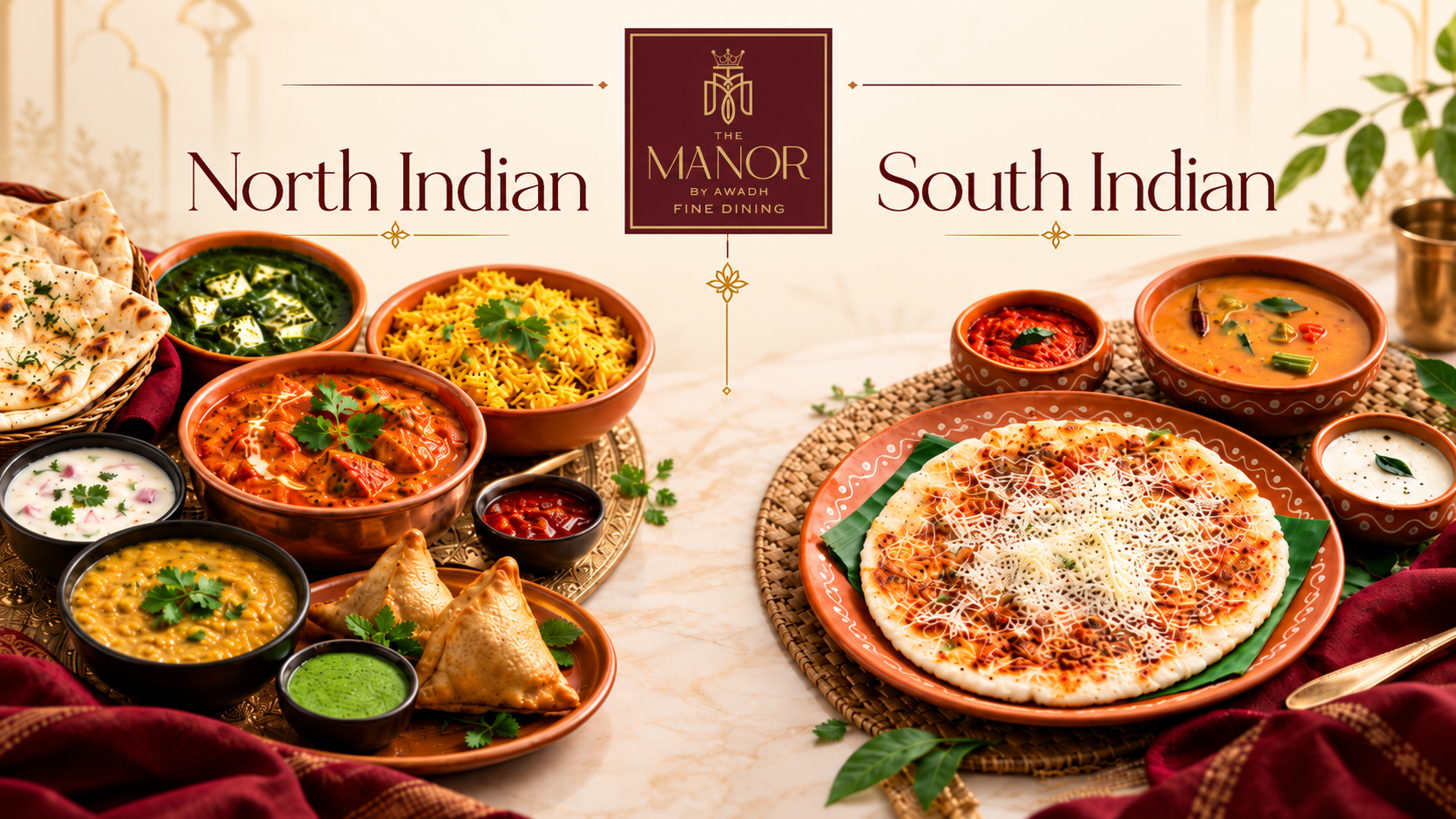
The clearer version of a combined menu doesn’t fold every region into one undifferentiated curry list. It keeps them separate, so a diner knows which kitchen a dish is coming from before it arrives. At The Manor in Tanjong Pagar, the 2026 menu is organised this way, with sections for South India, North India and a dedicated chapter for Awadh, Lucknow’s old court cuisine.
A Kerala-style stew called Nair’s Ivory Stew sits in the South Indian section, cooked in coconut milk and curry leaves; a Lucknowi kebab called the Kakori Cloud Kebab, made with slow-pounded meat and served on saffron sheermal, sits pages away in the Awadh section. Nothing about how they’re written pretends they came from the same tradition.
The instinct when a menu spans two regions is to order widely and hope it balances out. A sharper approach is to order for contrast on purpose. A pepper-forward South Indian curry sits well against a rich, saffron-laced North Indian one, because the two do opposite work on the palate: one cuts through, the other lingers. The same logic holds for starters, where a tangy, fried South Indian snack clears the way for a North Indian kebab that follows it, rather than competing with it.
It’s also worth checking that the vegetarian dishes carry the same regional range as the meat ones. South Indian vegetarian cooking, built on lentils, rice and vegetables, has a depth that a single paneer dish elsewhere on the menu can’t stand in for.
Dosa and idli are the two South Indian dishes most people outside India already know, which has left the impression that the region’s food is mostly breakfast fare. It isn’t. Behind those staples sits a full repertoire of biryanis, fish curries and festive thalis that rarely travel as far as the fermented crepes do.
North Indian food carries a different shorthand, usually reduced to heavy, cream-forward dishes across the board. Awadhi cooking shows the fuller picture. Its entire technique is restraint: spice layered slowly rather than piled on, closer in spirit to a long reduction than a rich sauce poured over meat. Neither region is a simplified version of the other, and neither is more authentic than the other. They’re two full traditions that happen to share a border.
This format is still the exception in Singapore’s Indian dining scene, where most kitchens specialise in one region rather than running both. Where it does appear, it tends to show up most clearly in a tasting menu, since that format can walk a diner through contrasting regions course by course instead of asking them to build the order themselves.
The Manor runs two such menus at $138 and $168 per person, one vegetarian and one not, each moving between dishes like the South Indian Moilee of Kerala Shores and the North Indian Dawn of Awadh Mutton Nihari rather than settling into one regional style for the whole meal.
South Indian cooking is built on rice, coconut, curry leaf, and fermentation, with tang and direct spicing doing most of the work. North Indian cooking leans on wheat, dairy, and slower technique, built around aroma and layered spice rather than raw heat.
No. Heat varies within each region rather than between them as a rule. Andhra Pradesh cooks fiercely hot, while Kerala, in the same region, is often mild and coconut-led.
Each region demands its own technique and timing, and a tandoor kitchen runs on a completely different rhythm from a fermentation-based one. Running both at a high standard takes more resources than most restaurants commit to.
Pair dishes for contrast rather than similarity: a tangy, fermented South Indian dish against a rich, slow-cooked North Indian one shows what actually separates the two kitchens.
A small number of restaurants structure their menu by region instead of blending it into one style. The Manor in Tanjong Pagar is one, with separate sections for South India, North India and Awadhi court cuisine, and two tasting menus that move between all three.