Most Indian menus sort dishes by type: starters, curries, breads, rice. The Manor, a fine dining restaurant at Amara Singapore in Tanjong Pagar, sorts them by place. Its 2026 menu, titled “A Journey Across India,” is divided into six regional sections: South India, West India, East India, Northeast India, North India and the Cuisine of Awadh. Each section has its own introduction, signature flavours, entrées and main courses, with a suggested wine and cocktail beside every dish.
The menu’s premise is stated plainly: India is not one cuisine but many, each shaped by land, climate and culture. Sorting dishes by region puts that idea into practice. Instead of choosing a “curry” and a “kebab,” you choose where in India you want to eat, then pick from that kitchen’s dishes. It also makes a mixed table easier to build, because every dish arrives with the context of where it comes from.
| Region | Menu tagline | Signature flavours named on the menu | A dish to know |
| South India | Coconut, Fire & Fermentation | Chettinad, Kodava, Kerala | Nair’s Ivory Stew, from $28 |
| West India | Coasts, Deserts & Spice Routes | Goa, Maharashtra, Rajasthan | Malvani Fish Fry, $28 |
| East India | Rivers, Rice & Subtlety | Bengal, Odisha, Bihar | Daab Chingri, $38 |
| Northeast India | Forests, Ferments & Firewood | Khasi, Naga, Assam | Himalayan Thukpa, $26 or $30 |
| North India | The Royal Courts & Rustic Hearths | Awadh, Punjab, Kashmir | Buttered Legacy with Burrata Crown, $36 |
| Cuisine of Awadh | The Royal Courts & Rustic Hearths | Dum pukht, galouti and kakori kebabs | Kakori Cloud Kebab, $40 |
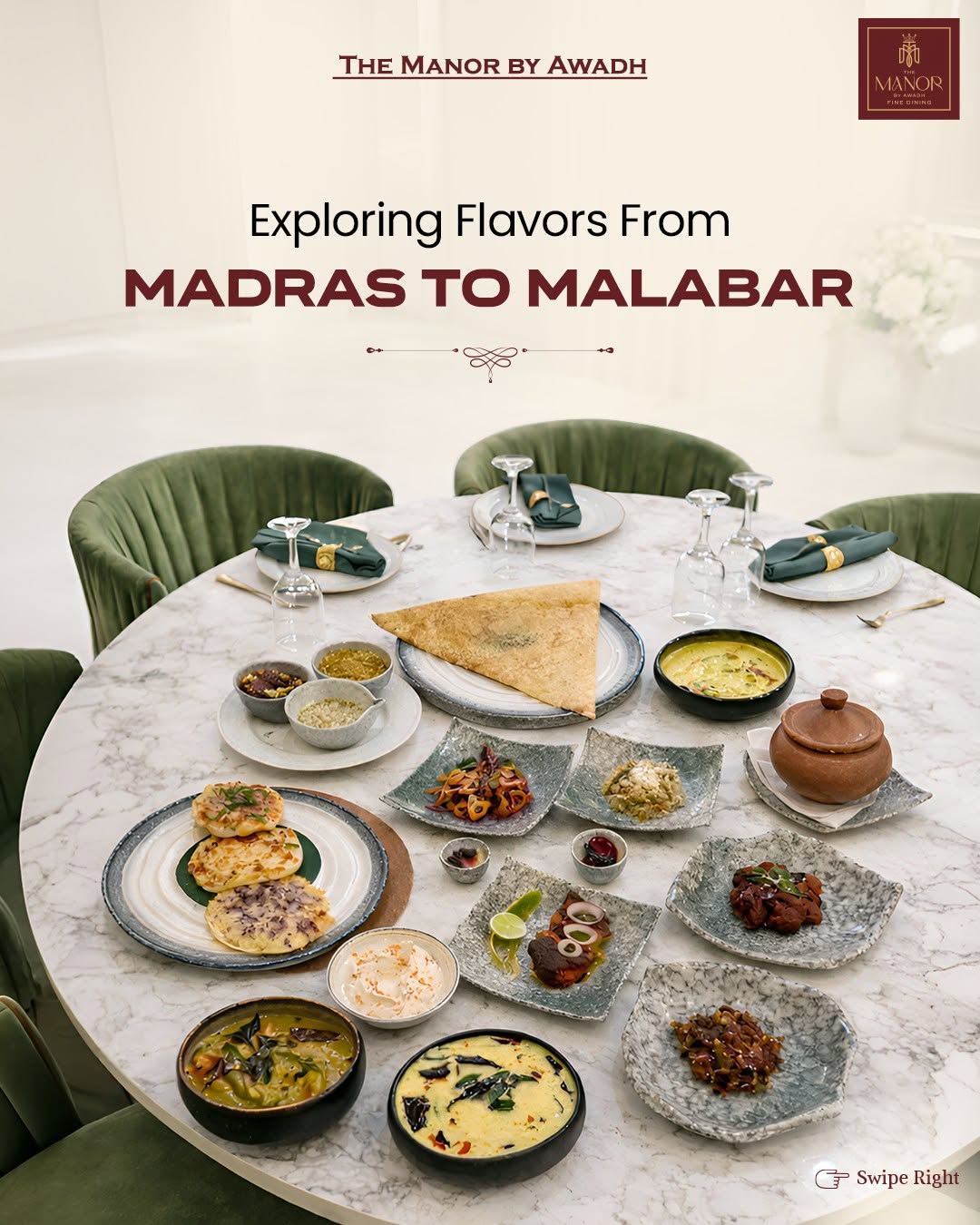
The South India section begins with Kerala, where the menu places dishes enriched with coconut milk and curry leaves, and moves to Tamil Nadu’s Chettinad cooking, built on black pepper, star anise, fennel and kalpasi, the stone flower. Fermentation is called sacred here, with dosa, idli, appam and puttu named as its expression.
The Nair’s Ivory Stew is a Kerala-style stew simmered in coconut milk and curry leaves, at $28 with potato, $32 with chicken, or $38 with mutton. The Chettinad Noir Chicken Curry, $32, is a fiery curry on a roasted black pepper masala. The Pollichattu Meen Leaf Parcel, $34, wraps fish in banana leaf with a Malabar masala and grills it.
The West India section names Goa, Maharashtra’s Malvani masala, Gujarat, and Rajasthan. The Malvani Fish Fry, $28, is pan-fried mackerel from the Malvan coast. The Vasco Da Gama Xacuti Chicken, $32, is a chicken curry from the Goan coast. The Rajasthani Gatta Curry, $24, cooks gram flour dumplings in a spiced yoghurt gravy.
The East India section is described as restrained and soulful, built on Bengal’s mustard and fish, Odisha’s temple-born dishes and Bihar’s smoky litti chokha. The Daab Chingri, $38, is a Bengali prawn curry cooked in fresh coconut milk. The Champaran Mutton Reverie, $38, is slow-roasted mutton with mustard oil and aromatic spices from Bihar. The Kasundi Croquettes, $34, pair fish croquettes with Bengali mustard mayo.
The Northeast India section, which the menu calls India’s least known yet most primal cuisine, lists dishes that lean Himalayan. The Himalayan Silken Dumplings, $26, are Tibetan and Nepalese chicken dumplings in a Nepali-inspired broth. The Himalayan Thukpa is a hearty noodle soup with flavours of Ladakh and Sikkim, $26 vegetarian or $30 chicken.
The North India section balances regal refinement with rustic warmth. Punjab is named for its tandoori cooking and hearty butter-rich dishes, and the Buttered Legacy with Burrata Crown, $36, is a classic butter chicken finished with burrata. The Dal of the Midnight Hearth, $28, is black lentils simmered overnight. For char and smoke, the StoneSeared Barrah, $46, is rock-seared lamb chops rubbed with cumin and smoked over flame.
Awadh gets a section of its own. The menu describes the cuisine of Lucknow as developed in the courts of the Nawabs in the 18th and 19th centuries, defined by refinement, restraint and technical mastery. Its heart is dum pukht, sealing a heavy pot so ingredients steam gently in their own aromas.
The menu is explicit that Awadhi cuisine is not about heat but about harmony. The Kakori Cloud Kebab, $40, comes on a saffron-kissed sheermal. The Seekh of the Nawabs is $34 in chicken or $36 in mutton. The Dawn of Awadh Mutton Nihari, $42, is mutton braised overnight with cloves, pepper, and mace.
At The Manor, a table can cross regions in a single order. The Imperial Fire Tasting Platter brings together Chicken Morani tikka, Kashmiri mutton seekh, Konkan prawns and coastal spice grilled fish, at $98 for two or $128 for four. The Chef and Sommelier Signature Tasting Menus run seven courses, at $138 per person for vegetarian and $168 per person for non-vegetarian, and the menu asks guests to check with the sommelier about charges for wine and cocktail pairing.
Pairings are listed dish by dish. On the 2026 menu, the Moilee of Kerala Shores is paired with a Spanish Albariño and the Toddy Tapper cocktail, and the Kakori Cloud Kebab with a Faiveley Mercurey Vieilles Vignes 2022 and the Betel Blossom Reverie cocktail. Dishes are marked as vegetarian, chicken, mutton, fish or prawns, and all prices are subject to service charge and government taxes.
Whether the cuisine is new to you or you already know the region well, a table at The Manor is an easy way to try it in a setting made for a proper sit-down meal. Browse the menu, choose a dish or two from the section that appeals, and reserve ahead so the evening is settled before you arrive.
Yes. The 2026 menu is divided into South India, West India, East India, Northeast India, North India, and the Cuisine of Awadh, each with its own introduction and dishes.
The menu describes it as the cuisine of Lucknow, developed in the courts of the Nawabs in the 18th and 19th centuries and built on dum pukht slow cooking.
Yes. Every dish on the menu lists a suggested wine and a suggested cocktail. For the tasting menus, check with the sommelier about pairing charges.
The seven-course tasting menus are $138 per person for vegetarian and $168 per person for non-vegetarian, before service charge and government taxes.
Tables can be reserved in advance through the restaurant’s booking channels, which are listed on its website. Booking early is a good idea for larger groups and special occasions.